In Minnesota’s climate, a crack in your asphalt isn’t just a cosmetic issue — it’s a ticking time bomb. Water enters through even the smallest crack, reaches the base layer, and when temperatures drop below freezing (which happens roughly 150 days per year in Minnesota), that water expands by 9%. This expansion widens the crack, allows more water in, and the cycle repeats with every freeze/thaw event. A hairline crack in October can become a pothole by April.
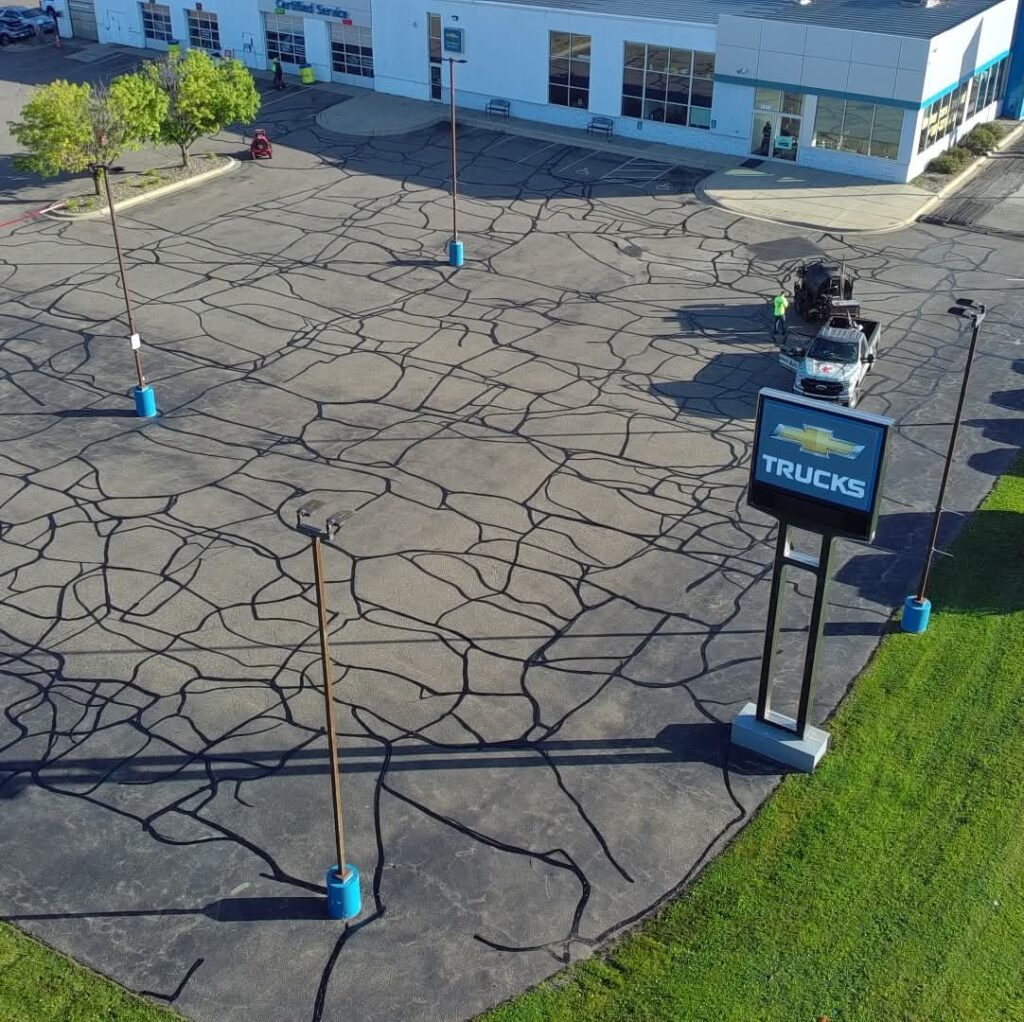
Asphalt Aces uses hot-pour rubberized crack sealant — the gold standard for crack repair in cold climates. Unlike cold-pour products sold at hardware stores, hot-pour sealant is heated to 375°F and applied in a molten state that bonds permanently to the crack walls. Once cooled, it remains flexible enough to expand and contract with Minnesota’s extreme temperature swings without breaking the seal.
Crack sealing is the single most cost-effective pavement maintenance strategy available. The Federal Highway Administration estimates that every $1 spent on crack sealing saves $6-8 in future repair costs. For Minnesota property owners, where freeze/thaw damage is the primary cause of pavement failure, that return on investment is even higher.
Minnesota experiences more freeze/thaw cycles than almost any other state — averaging 50-60 per winter in the Twin Cities metro. Each cycle drives water deeper into your pavement structure and widens existing cracks. Without intervention, a network of small cracks becomes alligator cracking, which indicates base failure and requires expensive full-depth repair or replacement.
Crack sealing before winter is especially important in Minnesota. The window between when cracks develop (typically late summer/early fall) and when the first hard freeze arrives (typically November) is your opportunity to prevent an entire winter’s worth of freeze/thaw damage. Missing this window can mean the difference between a $300 crack sealing job and a $3,000 patch repair in spring.
For commercial properties, crack sealing also prevents liability issues. Cracks that develop into potholes or uneven surfaces create trip-and-fall hazards. A documented crack sealing program demonstrates proactive maintenance and can protect property owners from premises liability claims.

We inspect every crack, categorizing by width, depth, and type (linear, alligator, edge). This determines the appropriate treatment method for each area.

Cracks are cleaned of debris, vegetation, and loose material using compressed air and wire brushing to ensure proper sealant adhesion.

Rubberized sealant heated to 375°F is applied into each crack, filling from the bottom up to ensure complete penetration and bonding.

Excess sealant is leveled flush with the surrounding surface for a clean appearance and to prevent plow blade catching in winter.

Sealant cures quickly — typically ready for traffic within 30-60 minutes depending on temperature.
Minnesota’s climate is uniquely destructive to asphalt. The Twin Cities metro area averages 170 days per year with temperatures below 32°F, and the temperature regularly swings 30-40 degrees within a single day during spring and fall transition periods. These rapid temperature changes create the most damaging freeze/thaw conditions — far more destructive than a sustained deep freeze.|
The ideal time for crack sealing in Minnesota is late summer through early fall (August-October), after the summer heat has opened cracks to their widest point and before the first hard freeze. Sealing cracks at their maximum width ensures the sealant fills the entire void and has room to compress when temperatures drop.
We also recommend crack sealing as a precursor to sealcoating. Filling cracks before applying sealcoat creates a smooth, watertight surface that maximizes the protective benefit of both treatments. This one-two approach is the most effective maintenance strategy for Minnesota asphalt.
A typical residential crack sealing job costs $150-$400. Left untreated, those same cracks will develop into potholes and base failures costing $1,000-$5,000 to repair — or contribute to a full driveway replacement at $3,000-$8,000. For commercial properties, the savings are even more dramatic: a $500-$2,000 annual crack sealing program can prevent $10,000-$50,000 in premature lot replacement.
Crack sealing uses hot-pour rubberized material that bonds to crack walls and remains flexible through temperature changes. Crack filling uses cold-pour material that simply fills the void. In Minnesota’s climate, crack sealing is far more effective and longer-lasting.
Hot-pour sealant can be applied in temperatures as low as 40°F, but ideal conditions are above 50°F. We typically seal cracks from April through November in Minnesota.
In Minnesota’s climate, quality hot-pour crack sealant typically lasts 3-5 years before needing reapplication. Annual inspection helps us catch any areas that need touch-up.
Get a free, no-pressure estimate from Gennadiy himself. We’ll assess your asphalt and recommend the best solution for your property.
Owned and operated by Gennadiy since 2009. Professional asphalt maintenance for the South Twin Cities Metro. Quality work, lasting results.
© 2026 Asphalt Aces. All rights reserved.